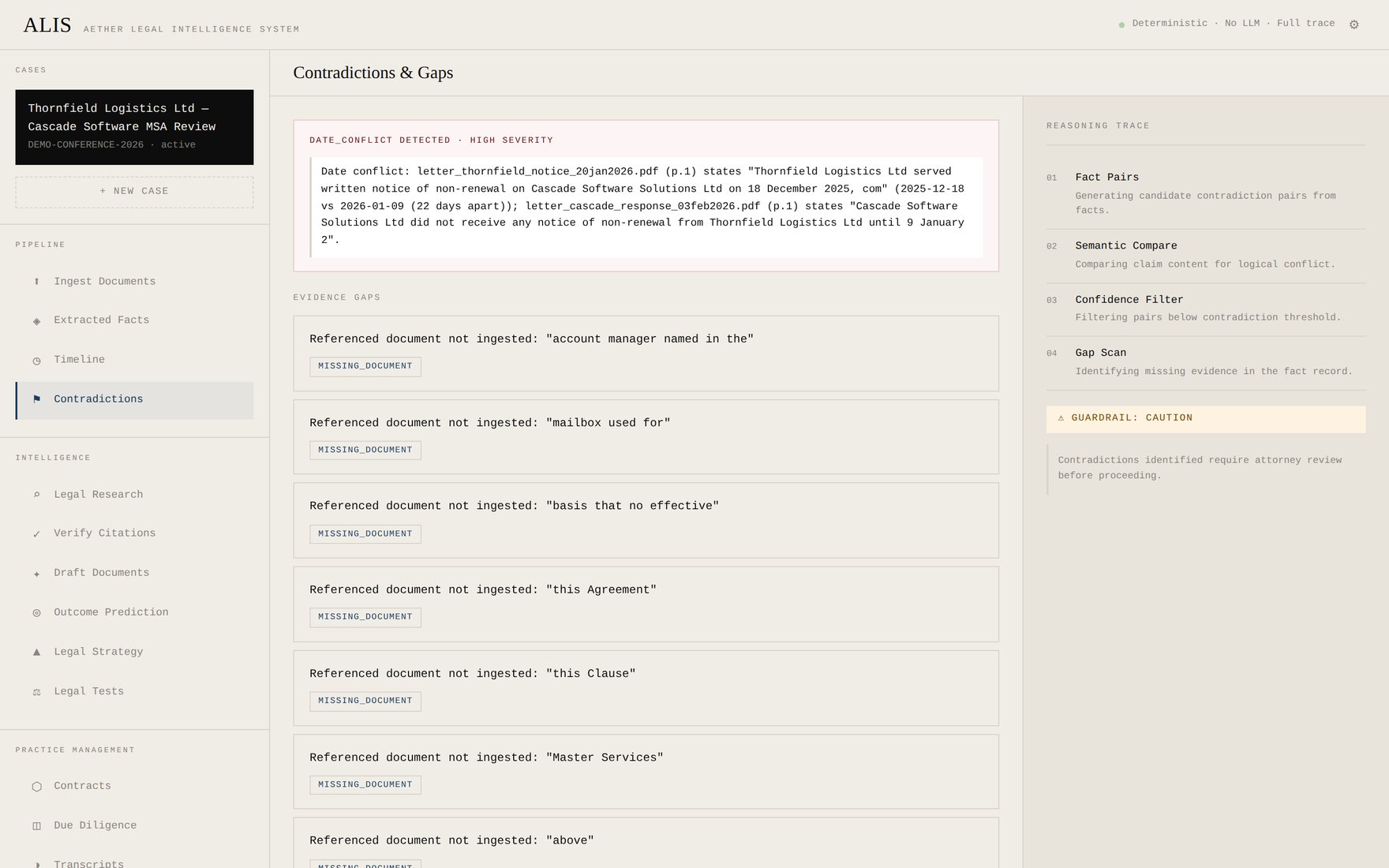
Case reconstruction
Extract dated facts, obligations, events and claims from case files, with every material fact tied back to its exact source.
Legal intelligence software that analyzes case files and legal documents, reconstructs events, verifies claims and citations, and derives its conclusions directly from the evidence available.
Built for matters where plausibility is not enough.
ALIS grounds its outputs in your firm's documents and a real case-law
corpus, with source references attached to the underlying material.
Self-hosted deployment keeps matter data within your firm's infrastructure.
ALIS does not rely on a language model to generate a legal conclusion. It builds a structured representation of the matter, applies explicit rules and deterministic algorithms, and traces every conclusion back to the evidence that supports it.
Drafts and redlines are assembled from approved templates and verified facts. Outcome assessments are calculated from explicit, weighted factors. Legal tests are broken down into their individual elements. Every result is designed to be inspectable, reproducible, and auditable.
ALIS is designed around a simple constraint: every legal conclusion should be traceable back to the evidence and authorities from which it was derived.
Facts and conclusions are tied to the documents and authorities available to the system, rather than invented from a blank context.
Every material finding can point back to its source — down to the document and page where possible.
ALIS is designed for self-hosted deployment, keeping sensitive matter data within the firm's own environment.
ALIS turns unstructured legal material into facts, timelines, authorities, conflicts and working drafts that lawyers can inspect.
Extract dated facts, obligations, events and claims from case files, with every material fact tied back to its exact source.
Build a chronological matter timeline, identify corroborated events, and surface conflicting dates, statuses and accounts with severity.
Find documents, reports and other evidence referenced by the record but never actually supplied to the matter.
Bring facts, events, contradictions and evidence gaps together in one inspectable representation of the matter.
Identify admissions, inconsistencies, hedging language and other material signals across transcripts and depositions.
Answer legal questions against an indexed case-law corpus and rank relevant precedent against the issue being examined.
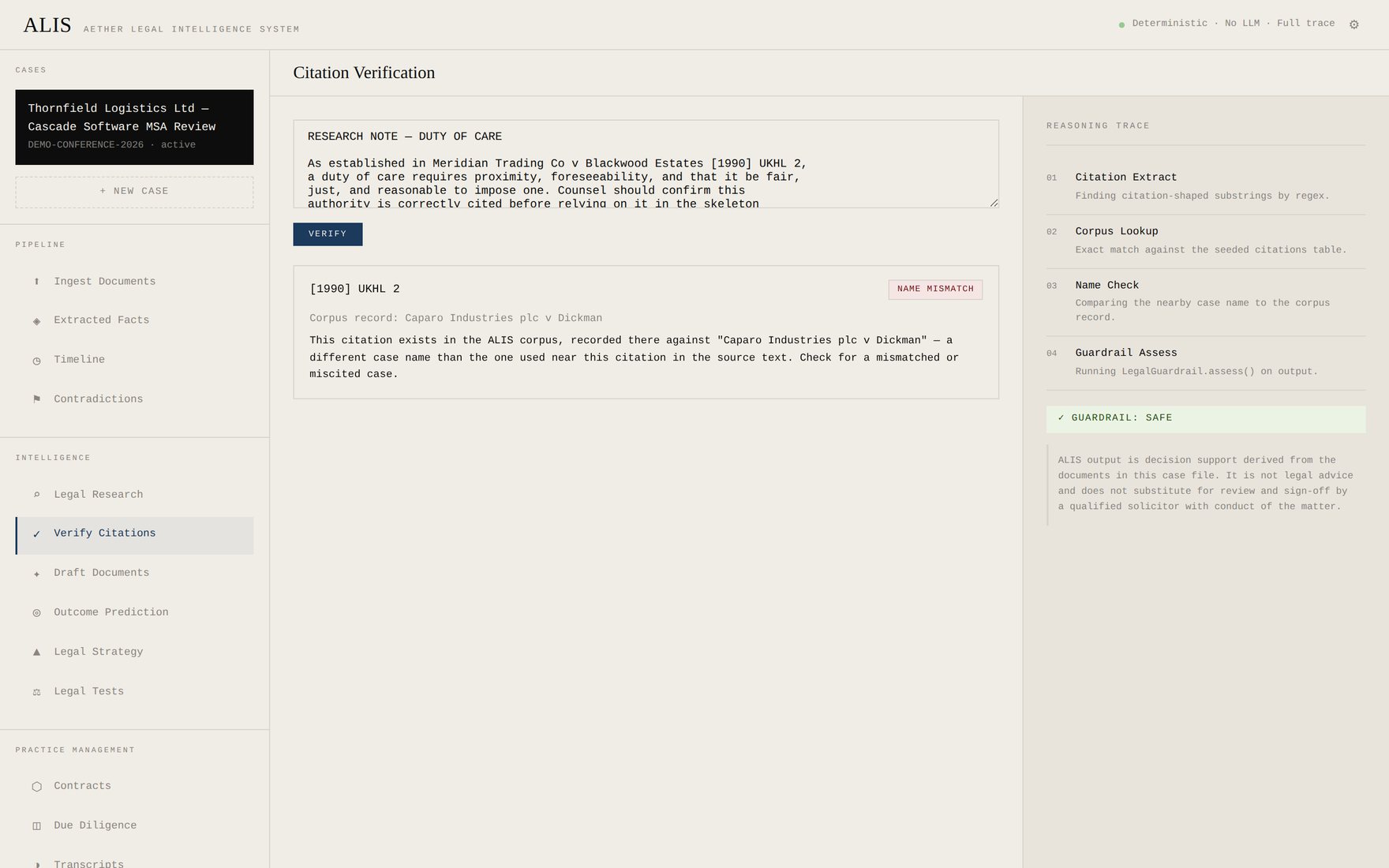
Check citations against the underlying case-law corpus and flag authorities where the citation, case or proposition does not match.
Evaluate each element of a defined legal test against the case facts separately, so the lawyer can inspect every step.
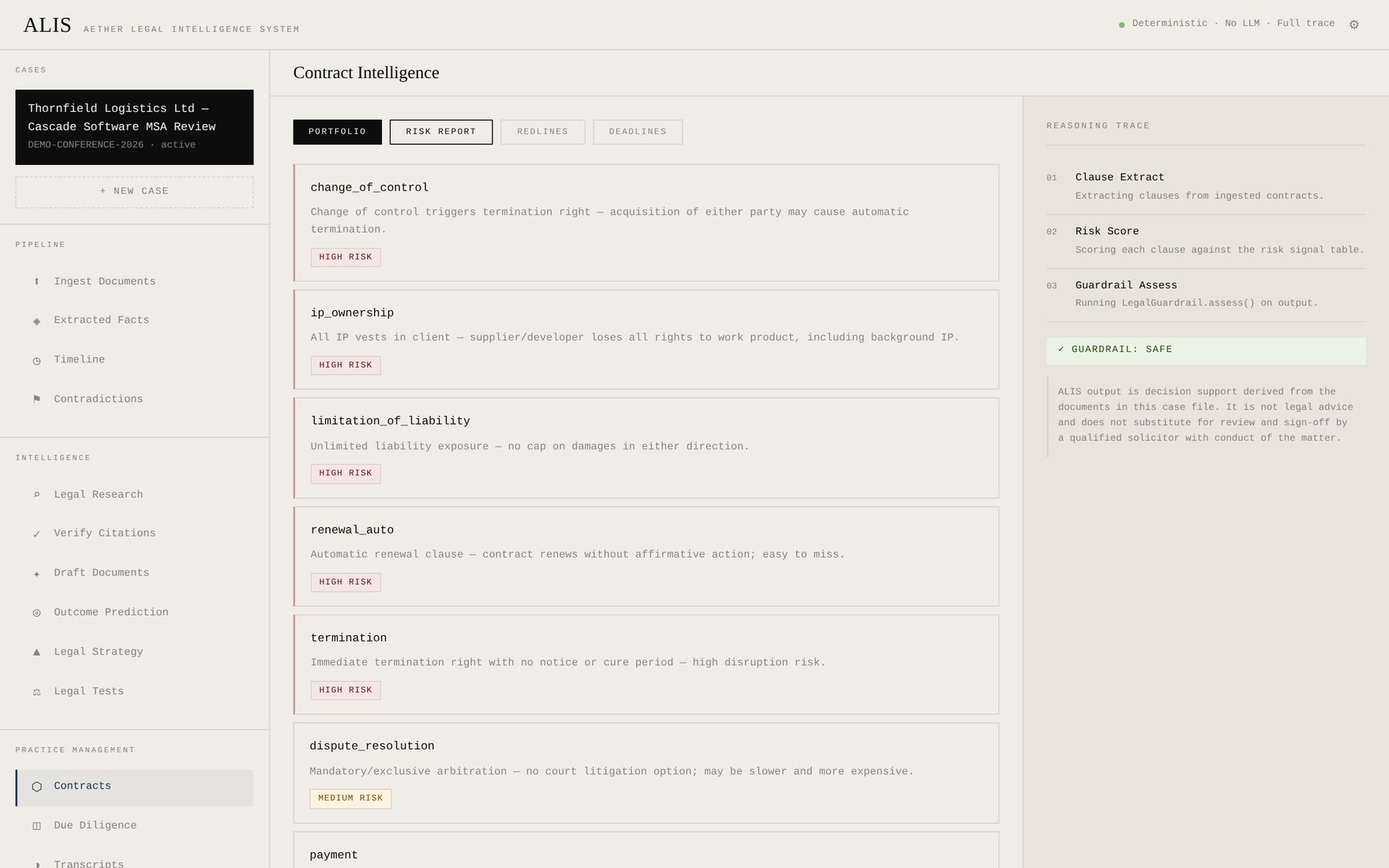
Extract clauses, classify their characteristics and score risk against the firm's configured rules and playbooks.
Generate proposed replacement language from approved clause templates rather than inventing contractual language from scratch.
Roll contract risk, obligations, deadlines and renewal windows into a single portfolio view, including M&A diligence.
Estimate case outcomes from explicit weighted factors, expose the factor breakdown, and track calibration against real results.
Structure the key issues, arguments and counterarguments around the matter's actual facts and legal framework.
Search the firm's memos, precedents and prior matters by question, with similar-case suggestions alongside the result.
Roll multiple matters into a client-level view of risk, exposure and opportunities.
Track contractual deadlines and generate billing information from the matter activity already recorded by the system.
Apply firm-specific playbooks, severity overrides and a human-reviewed terminology glossary on top of the base intelligence engine.
The system is built as a pipeline: acquire the record, structure it, retrieve relevant authority, reason over the resulting evidence graph, and expose the path back to the source.
Case files, contracts, correspondence, pleadings and firm knowledge.
Facts, entities, dates, claims, obligations and relationships become machine-readable.
Relevant authorities and prior firm work are located against the question.
Rules, evidence, conflicts and relationships are evaluated against the matter.
Findings remain connected to the record so a lawyer can inspect the basis.
One system for practices that want meaningful AI leverage without surrendering control over sensitive matters or source verification.
Automate the tedious first pass across documents, research, chronology and matter administration without building an internal AI team.
Make prior matters, precedents and internal research searchable and reusable while maintaining firm-level control.
Self-hosted deployment is designed for firms that need sensitive client and matter information to remain on their own infrastructure.
ALIS is deployed once per firm and operated on infrastructure controlled by the firm. The architecture is intended for legal environments where confidentiality, traceability and operational control matter.
No per-seat architecture. No requirement to send matter files to a third-party hosted workspace. Deploy the system inside the firm's environment and control access, storage and operational policy.
ALIS is licensed once per firm, not once per lawyer. Every attorney gets full access to the platform — no per-seat pricing, no metered queries, no individual subscriptions to manage.
Pricing for US and international firms, billed annually.
Implementation and deployment — infrastructure, data migration, firm playbooks — are scoped and quoted separately from the annual license. GBP and NGN pricing is indicative and payable via arrangement — contact us to confirm current rates and payment method.
Attorney counts mark where a tier's capacity ends, not what's being sold. The firm licenses ALIS once, and every attorney inside that capacity gets full access to it.
ALIS is deployed once per firm as a self-hosted system. Start with a pilot and evaluate it against real matter workflows.
rickclmntcorp@protonmail.com